System Change: Why We Should Manage the Missing Middle

Fieldwork in women’s empowerment has shown us that root causes are complex and intertwined, embracing cultural and educational elements of a society.
Let’s examine this complex web of relationships with the goal of increasing the number of women and girls in science and STEM fields.
Before we deep dive into this example, let me introduce the system change framework- adapted from “ The 5R Framework by the USAID” by Ashoka, a platform that builds and cultivates a community of change leaders, mostly social entrepreneurs. Ashoka encourages social entrepreneurs tackling social challenges to change systems or mindsets to scale impact.
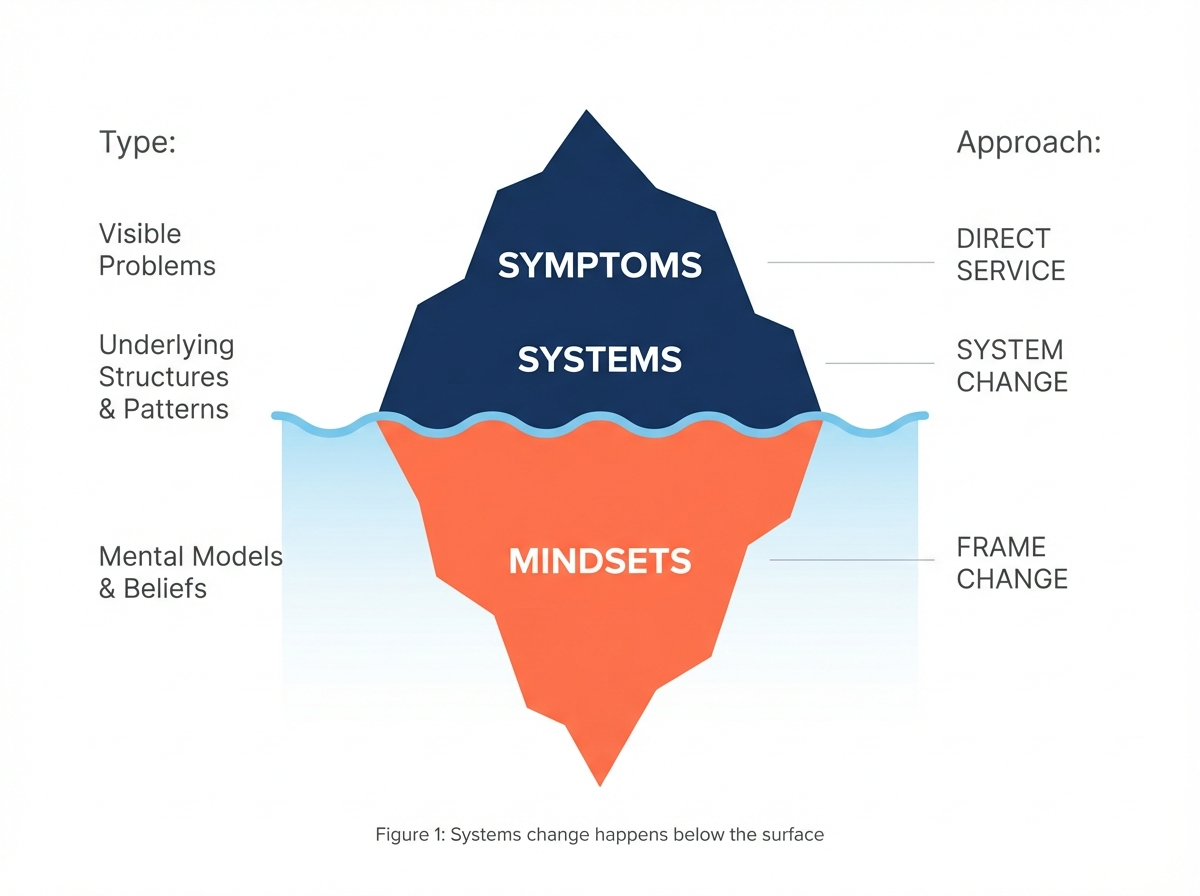
As Figure 1 shows, a system change targets a change in the root causes of an issue, as opposed to a surface-level change which only addresses symptoms. When we address symptoms, we add positive outcomes to existing dynamics. Instead, system change requires a break away from the linear relationship and instead employs strategies based on scaling indirect impact and changing existing dynamics.
Going back to our example, a direct service would be giving girls aspiring to study in STEM fields scholarships. No root cause is addressed, and more positive outcomes are encouraged- more women in STEM fields.
Let’s look at the systems that interact and drive as the root causes of why we do not have an equal number of men and women in STEM. The root causes outlined below are not an exhaustive list. We will call each distinct root cause- a system. Most of our examples will be from Turkey where we do fieldwork:
- Cultural system: The norms and values imposed by society that defines a fulfilled and happy woman. In Turkey, a woman’s status in society is mostly defined by her being a great mom and cook.
- Media systems: There is a lack of awareness about the fact that we have fewer women in STEM fields; women get paid less than men (in different countries and fields different rates apply); very few companies provide equal opportunities at the workplace.
- Education systems: In Turkey, parents are heavily involved in the university major selection of their children; We have a national exam where a teenager picks his/her field of study, gets a score, and is placed based on his/her score and choices. As a result, 70% of university graduates do not work in their field of study.
- Mobility systems: Women are less mobile with their education and workplace options. If single, most families do not want their unwed daughters to work and stay in a different city on their own.
- University career development systems: Career counseling is not gender-sensitive and one size does not fit all.
- Systems of career orientation- formal or informal: Lack of role models and informal networking opportunities.
- Human resources placement systems: Lack of part-time or flexible jobs; gender biases re: sectoral or functional placements.
- Childcare system: There is a big motherhood premium in Turkish society; Every woman aspires to be a mother; The government child-care support incentives are not sufficient.
- Parent education systems: Men do not
- Local job markets system: Even if a woman graduates from a top science field from a top university, most of the time, she is expected to go back to her hometown, stay with family and find a job. However, a smaller town may not have fulfilling or inspiring job opportunities. Even if they exist, they are hard to find.
Systems are always in flux and interact with each other. Each system has resources, rules, and outcomes. Typically, every NGO, public institution, or social entrepreneur works with one system and one system only. There is a lack of coordination among our systems to scale the impact. We can create system change by:
- unlocking new resources for the system to draw on
- introducing new elements to the system / or getting rid off
- changing the relationships between elements of the system
- improving flows of information between the actors in the system
- changing the rules that govern behavior in the system
- changing the mindsets of the actors in the system
Acceleration happens when we add:
- Digital missing middle platforms to coordinate actors
- Diaspora human capital is eager to contribute
- Citizen participation — people wanting to be part of solutions
Digital platforms can improve information flow and scale impact.
The Opportunity: Future of Work and Mindset Shift
Now is the best time ever to scale impact and create a new world order.
Why? We have a mindset change driven by the seismic waves of future of work worldwide.
In the job market, the supply of jobs and their requirements are changing.
According to a popular report, 65% of children in primary school today will work at jobs that do not yet exist. Well, if all these jobs will be newly created, we have a fresh start when it comes to gender biases. A woman may push against biases to become a truck driver today, but the same social structure may not exist for a drone driver position.
Automation and human robot integration in manufacturing or other physical jobs will also be eliminated, removing another barrier for women.
Furthermore, some of the most desired future of skills like coordinating with others or empathy are female leadership traits.
On the demand side, the emerging workforce is seeking meaning and flexibility from their employers.
A new demographic climbing up the workforce ladder is demanding a different world order as well. In 2025, 75% of the global workforce will be composed of millennials. For starters, millennials seek inspiration and meaning at the workplace—not only from their leaders but also from their peers. Second, they want to volunteer for causes and combine meaning and work under the same roof. Third, they demand a flexible workplace and a company to help them realize their potential with individual attention, i.e., agile human resources capabilities at their place of work. Last but not least, millennials demand what we women did not push for in the past: flexible work environments.
It is needless to say companies are struggling to shape the future—not only is their end-consumer changing with different demands, but also new technologies are changing competition dynamics. The cherry on top is the chaos inside the house—employees have changing demands—raised very vocally by the millennials, pushing companies to new ways to capture and engage talented employees across all levels—a first since the industrial revolution—in my opinion. The job creation and destruction tied to automation and new job creation put yet another pressure on the companies. The pace of change has never been this fast. And it will accelerate at a flipping point—the timing of which is uncertain. If we cannot manage this, what will happen then?
The companies are feeling the pressure. According to Deloitte’s 2016 Global Human Capital Trends report, 92% of business leaders have identified the critical need to redesign their organization to meet global business demands. Yet, only 14% of them believe their company is ready to effectively redesign their organization. Nothing seems to have changed since. It is a do or die world for the companies.
The job market participants feel the pressure. The future is exciting yet uncertain. When we know that 47% of the jobs will disappear by 2033, what guarantees me that it will not be my job? How can invest in our skills and capabilities to stay relevant or competitive? We do not know the jobs of the future. The only reasonable response is to continuously learn not only from books, online courses, or second degrees but also from our peers, in formal and informal ways.
Learning quotient is the new asset, not a college degree. In the emerging new era, companies like Google are no longer seeking a university degree when applying to desirable positions. This changing trend not only makes rising university students doubt their investment and the value of their education, but it also levels the field for people with self-learning capabilities with limited access to funding. None of these facts challenges the value of education systems. As the pace of information flow accelerates, universities may emerge as the curators of education and career guidance networks—moving away from education delivery destinations.
To sum up, the future of workforce changes the rules of the job market as we know it, making it more accessible and equitable for self-learners. As the rules change, this sliding window may be very precious for women to shape the future of the workforce: the workplaces will offer more flexibility; physically demanding jobs will be eliminated over time—where women are discriminated against; the education barrier to jobs is being lowered—self-learners will have more paths to value-added jobs; and companies know what got them here will not get them any further.
If we, the people, governments, companies, and NGOs, can collaborate as a collective to create a safe, trusted place—the missing middle—now is the time to change the workforce composition diversely and equitably.
If unmanaged, this turbulence could widen inequality. If harnessed, it opens opportunity.
New Change Agents: People, Diaspora, and Digital Power
Shaping the future may never have been this challenging. The pace of change is both exhilarating and frustrating—depending on your perspective. I firmly believe we have a sliding window to build a new world order if we can lead our human capital to realize their potential and shape an equitable future for all. The opportunity is too big to pass up—not only for women or women in science but for all nations to exist in the peaceful and fully optimized world order of the future.
What is challenging us today? Our old worldview and ways of thinking or working. We expect our governments, thought leaders, prominent universities, and “others” to find a solution to this “future of work” challenge, i.e., find a fix for us all to apply. Well, this is a new world order where agility of execution is key and queen to shape and ride the waves of change. By design, large institutions such as the government, international organisations, or universities are not agile.
We, the people or individuals, are the most agile change agents, waiting to be harnessed in a transparent and open co-creation platform.
We, the people, individuals, are the most agile change agents, waiting to be harnessed in a transparent and open co-creation platform.
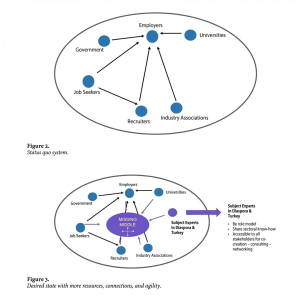
We had introduced the elements of systems change to achieve equality in STEM fields in education and the workforce. Let us focus only on two root causes: systems of formal or informal career orientation and human resource placement systems. The roles and interactions of the system elements are roughly outlined in Figure 2. The mapping may be different for each country. Today, not only are the linkages among the system participants changing, but each participant is also going through a major transformation. Every internal transformation draws energy within and away from collaborative efforts.
We believe that it is time for co-creation. No company or country will be able to solve their future of work challenges on their own without leaving a huge untapped human capital potential on the table. Companies have been more actively collaborating on social issues across borders. Whether it is transforming a nation or the world, we believe we have one untapped asset and a new way of collaboration to add to a new world order.
We, the people, we want to be part of the solution: We, individuals, would like to co-create to shape the future and are asking for a role and way to contribute to the solution. With few exceptions, the best and brightest human capital resources of a country live in the Diaspora. Although these people do not want to relocate back to homeland, they are eager to contribute to the economic development of their countries. A digital connection and micro-action platform can bridge this gap.
Collaboration in a digital, missing middle platform: If we can build a digital, trusted gathering place for lifelong learners who would like to update or share their skills, we can easily find digital ways for all stakeholders in the system to connect and improve the information flows.
In the desired state, we will have more resources, connections, and agility as depicted in Figure 3.
People want to be part of the solution.
Diaspora communities hold top talent willing to contribute without relocating. Digital platforms enable micro-actions and knowledge sharing.
A trusted digital “missing middle” platform can:
- Connect lifelong learners
- Improve information flows
- Add agility and resources
- Enable collaboration across stakeholders
The desired state includes more resources, stronger connections, and greater agility.
Collective Action Communities as the Missing Middle
The “missing middle” is often described as a coordination gap between institutions and individuals — between policy and practice, between opportunity and access.
But in practice, the missing middle is not only a platform. It is a community in motion.
A trusted collective action community can function as this missing middle by connecting people, knowledge, and opportunities across systems.
Collective action communities do three critical things:
They mobilize human capital. Individuals who want to contribute — mentors, experts, role models, diaspora leaders — are given meaningful ways to share knowledge and networks.
They improve information flow. Opportunities, insights, and lived experiences travel faster when communities are built on trust and shared purpose.
They enable co-creation. Instead of waiting for top-down solutions, communities experiment, learn, and adapt together.
This is where collective action becomes a systems-change tool.
At TurkishWIN and through platforms like BinYaprak, we see how a community can act as a living missing middle — connecting seekers, experts, companies, and NGOs in a dynamic ecosystem.
When communities become trusted spaces for exchange and contribution, they do more than fill gaps. They reshape flows of knowledge, access, and opportunity.
In that sense, the missing middle is not empty. It is waiting to be activated by people who care enough to co-create solutions.
And when collective action is sustained, what begins as a coordination role evolves into a culture shift — where collaboration becomes the norm, not the exception.